

Tempusvivendi
Crane
 |  |
|---|---|
 |  |
 |
Tempusvivendi Crane
In Europe, the crane was respected as an instrument of godlike will, greatly admired in antiquity primarily because of its indefatigable ability to fly great distances. At that time, migratory formation flights around the Mediterranean were considered awe-inspiring, and the bird was appropriately revered.
The crane’s remarkable process of courtship was considered an exemplary expression of joy in life and love, as well as majesty and pride. This bird was also greatly admired for its ability to exterminate snakes and its invulnerability to harm. These attributes often made it the perfect symbol for the visual language of heraldry, and thus the crane made an appearance in many coats of arms.
In the Middle Kingdom, the ancient characters for the crane have the same pronunciation as the characters for luck and success in many languages spoken in the Chinese empire. It was also thought that cranes lived exceptionally long lives, which earned them mythical attributes. A long life was considered one life’s five possible fortunes. The long life referred to in this case was not solely life on earth, but included the afterlife. In the various Chinese belief systems, life did not cease at death, but merely shifted to another, higher level. This is the reason why the crane is also to be discovered embroidered in gold on ancient funereal dresses.
The crane Tsuru is a respected and revered symbolic animal of the Japanese island kingdom. The Japanese, like the Chinese, attributed longevity and many other special qualities to the crane, some also concerning its beauty and character. Its grace and calm demeanor at rest as well as elegance in motion received much attention and acknowledgment.
The proximity of cranes to human dwellings contributed much to its worship - particularly the mother birds protecting their brood in a similar fashion to humans. This contributed to the fact that the animals were always treated with the greatest admiration and consideration. The arrival of the Tsuru was interpreted as a prophetic mark for “great good fortune.”
The Crane, time eternal.
I Am Interested!

Retrograde Time Indication
The Tempusvivendi Line features an elegant retrograde display in which the indicator sweeps across a calibrated arc before instantly returning to its starting position. This dynamic mechanism transforms the passage of time into a precise mechanical performance, highlighting both technical ingenuity and visual refinement.

Hours & Minutes
The watch presents a clear and balanced display of hours, and minutes, ensuring excellent legibility while maintaining its distinctive design language. Each indication is carefully integrated into the dial architecture, combining functional precision with refined aesthetic harmony.

Push for Time
A discreet push mechanism allows the wearer to interact directly with the timepiece, switching between the time display and the standard position, often referred to as the “lucky face.” This precise and satisfying action adds a playful yet sophisticated mechanical feature, reflecting the watch’s unique character and inventive design.
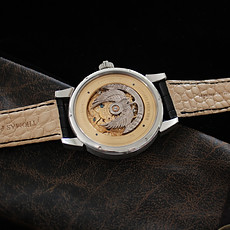
Oscillating Weight
Visible through the caseback, the oscillating weight powers the automatic movement through the natural motion of the wrist. Finely crafted and precisely balanced, it ensures efficient winding while offering a captivating view of the mechanical artistry within.